|
|
 |
IN THE FOOTSTEPS OF PAUL GREECE TOUR & TURKEY TOUR - 14 nights/16 days, arrive any day |
|
|
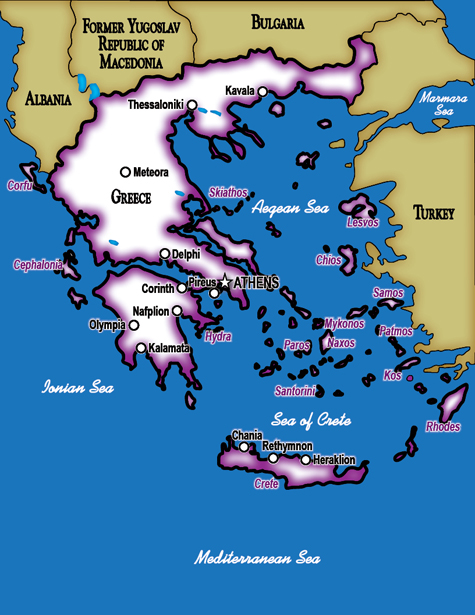
3 nts in Athens
1 nt Kalambaka
2 nights in
Thessaloniki
1 nt in Kavala
1 nt Canakkale
3 nts in Izmir
3 nts Istanbul
|
 |
Prices are on request.
This tour is available for parties of any size but is most cost effective for groups of 15 or more.
|
|
This private Greece tour / Turkey tour combines the best in Christian pilgrimage travel to Greece and Christian pilgrimage travel to Turkey in one comprehensive tour.
|
|
 |
Depart the U.S.

Upon arrival in Athens, you will be met by a Ya’lla Tours USA representative and transferred to your hotel for overnight.
This morning, take a 1/2-day city tour of Athens. This tour highlights the striking contrasts that make Athens such a fascinating city. We start with a driving tour past the Panathenaic Stadium, where the first modern Olympic Games were held in 1896. Continue driving by the Temple of Olympian Zeus, Hadrian's Arch, the Parliament and the Monument of the Unknown Soldier, the Academy, the University, the National Library, and Constitution Square (Syntagma).
At the Acropolis, visit the architectural masterpieces of the Golden Age of Athens: the Propylaea, the Temple of Athena Nike, the Erechtheion and finally “the harmony between material and spirit,” the monument that “puts order in the mind,” the Parthenon. Continue to visit the New Acropolis Museum, where beautiful statues from the acropolis have found a home.
Return to your hotel for overnight.
Drive the historic coast road to Corinth, where Paul ministered for nearly two years and wrote the earliest New Testament writings, The Letters to Thessalonians. The columns of Apollo Temple dominate the Agora. See the tribunal before which Paul was dragged, but where Gallio refused to pass judgment on him. Continue to the beautiful Peloponnese and the ancient city of Mycenae, the center of Europe's first civilization. Proceed to the great Theater of Epidaurus and the ruins of the Asklepion. Return to Athens along the new scenic road with magnificent views of the Saronic Gulf and the ancient port of Conchreas from which Paul sailed to Ephesus.
Depart for Delphi, nestled in the mountains of Parnassus with an unforgettable view across acres of olive trees as far as the Gulf of Corinth. It was the site of the famous Oracle of Apollo and a city of fame and wealth considered by early Greeks to be the center of the world. In the afternoon, depart to Kalambaka for dinner and overnight.
Visit Meteora, where Byzantine monasteries perch atop gigantic rocks, each standing alone in space; some over 1,000 feet high. In the Byzantine period, the monastic communities were important centers for art. Today, some of the monasteries are still occupied by religious orders. Depart Kalambaka to Larisa, the fourth largest city in Greece, and on through the valley of Tempe along the green water of River Pinios. Continue on through Katerini to the beautiful and cosmopolitan city of Thessaloniki.
Thessaloniki is also known as Salonika. The New Testament books of Thessalonians are Paul’s correspondence with the people of this church. Visit the old city ramparts, the Archaeological Museum, St. George Church, an ancient Roman monument which was transformed into a church, and the Galerius Arch, which rises over the famous Via Egnatia. Also visit two of the most beautiful basilicas in the city, St. Dimetrius, dedicated to a distinguished member of the Roman army and a martyred Christian convert, and St. Sophia. Continue to the ancient site of Veria, a modern shrine which commemorates Paul’s visit, and to Vergina, one of the most important sites in Northern Greece.
Head north from Thessaloniki to Philippi, the first great city in Europe visited by Paul.
It lies astride the Via Egnatia, the road that connected Rome with Constantinople. Visit the extensive ruins of Philippi and see where Paul was imprisoned. Walk by the stream near the modern village of Lydia where the first baptism in Europe took place. Continue to Kavala.
|
|
The ancient port of Kavala was known as Neopolis in New Testament times. See the attractive port and the 16th-century aqueduct, built by Suleiman the Magnificent. Then drive to the border where you will be met by your Turkish tour guide and continue to Canakkale.
Visit Troy, the legendary city-state of Homer’s Iliad. See the excavations showing several layers of this civilization, and the replica of the infamous Wooden Horse. Continue to Pergamum, the most favored of the Seven Churches of Revelation. Christianity reached Pergamum very early and the church there was praised for its forbearance in times of persecution. It was here that the first Christians were executed by Rome. Visit the stunning acropolis of the Hellenistic city, perched 1,000 feet above the town. Continue to Izmir.
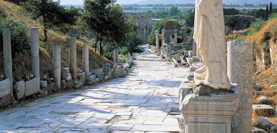
This morning in Izmir (ancient Smyrna) visit the ancient Church of St. Policarp, which symbolized the community of the Seven Churches of the Apocalypse. Then drive to the spectacular ruins of Ephesus, undoubtedly the best preserved Classical city in the Mediterranean. Ephesus was a large port with a population of over 250,000, the boomtown of Asia Minor. It was the site of one of the Seven Churches of the Revelation and St. Paul lived and preached here. The Temple of Artemis at Ephesus was one of the Seven Wonders of the Ancient World. A short drive away, the Basilica of St. John sits atop the remains of St. John. End the day at the Last House of the Virgin Mary, who was brought to Ephesus by John, the beloved disciple of Jesus. Return to Kusadasi.
Transfer to the pier to board your privately chartered, early morning ferry to Patmos. Visit St. John Monastery, where John wrote The Book of Revelation. Also see the Apocalypse Cave and the museum.
Return to Izmir by ferry.
Drive to Sardis, the capital of ancient Lydia and one of the Seven Churches of the Revelation. View the significant ruins of the Acropolis and visit the temple of Cybele and Diana, which later became a church. Then visit the reconstructed synagogue and the gymnasium. Continue to Hierapolis (modern Pamukkale), with its hot mineral springs and spa.
Paul introduced Christianity to this, one of the largest Roman cities in Asia Minor.
Transfer to Izmir airport for a short flight to Istanbul.
Visit the legendary Blue Mosque, decorated with beautiful 17th-century Iznik tiles. Then stroll around the historical Hippodrome, where chariot races were held. Visit the underground Crusader Cisterns. Continue to St. Sophia, a Christian basilica built by Justinian in the 6th-century and converted to a mosque during the Ottoman Empire. See the beautiful mosaics on display in the museum. Continue to the Egyptian Spice Bazaar, used as the spice market since 1665.
Next, take a ferry ride on the Bosphorus.
Visit the Church of St. Savior in Chora, with remnants of mosaics from the 12th and 14th-centuries. Above the front door, you can still make out a kneeling Theodosius offering Christ a model of the church.
The whole story of the beginnings of Christianity is told on these walls. Continue to Topkapi Palace, legendary residence of the Ottoman sultans.
Then, enjoy some free time at the Grand Bazaar of Istanbul.
You will be transferred to the airport for your departure flight.
|
|
|
For a longer pilgrimage experience, ask us about combining this tour with a pilgrimage tour in Israel.
|
| Paul the Apostle visited Greece on his 2nd and 3rd missionary journies. He traveled his 2nd mission roughly from 49 to 52CE. During that time, he stayed in Corinth for 1.5 years. You can read about it in the Book of Acts 15:36-18:22. He visited Greece again on his third mission, 53-58CE, described in Acts 18:23-21:15. |
|
 |
|
 PER PERSON PRICING PER PERSON PRICING
On Request - Please call for quote.
|
 |
|
BRONZE
|
SILVER
|
GOLD
|
DIAMOND
|
|
N/A
|
N/A
|
N/A
|
N/A
|
|
|
|
|
|
|
|
|
|
BRONZE
|
SILVER
|
GOLD
|
DIAMOND
|
|
N/A
|
N/A
|
N/A
|
N/A
|
|
|
|
|
|
|
|
BRONZE
|
SILVER
|
GOLD
|
DIAMOND
|
|
N/A
|
N/A
|
N/A
|
N/A
|
|
|
|
|
 |
|
|
|
Hotels - to be customized
|
|
|
BRONZE
|
|
|
|
|
|
|
|
|
|
|
|
SILVER
|
|
|
|
|
|
|
|
|
GOLD
|
|
|
|
| |
|
|
|
|
|
|
DIAMOND
|
|
|
|
|
|
|
|
|
|
|
|
|
Travel Tips
Greece has a warm Mediterranean climate. In summer, dry hot days are often relieved by stiff breezes known as Meltemia, especially in the north and coastal areas. In the summer, Athens can be stiflingly hot, so visitors should allow time to acclimatize. The evenings are cool. Winters are mild in the south but much colder in the north. November to March is the rainy season.
The best time to visit is mid-May to mid-June and mid-September to the end of October.
Late June to September is hot, with low temperatures in the 70’s and highs in the 90’s. Winter months are generally fine for touring, but usually too cold to swim or lie on the beach. Average winter temperatures are a low of 44 and a high of 60. Greece has fairly little rain year-round.
A valid passport is required for entry into Greece. A visa must be obtained from the Greek Consulate if you intend to stay for longer than 3 months. Your passport must be valid for at least 6 months after your arrival into Greece.
Yellow fever certificate is required if you are arriving from an infected area.
Contact health authorities for the latest information.
Cool, loose cotton clothing is recommended for most of the year. In the winter a light coat and sweat shirt is advisable. Sun hat, sunglasses and plenty of fluids help to cope with the heat.
As a member of the EU, Greece’s currency is the Euro. Money can be exchanged at banks and hotels as well as money changers and ATM’s.
The electric current is 220 volts AC. The wall plugs are the round, two pronged European type; bring an adapter if necessary.
|
|
|
|
|
|
|
|
|
|
|