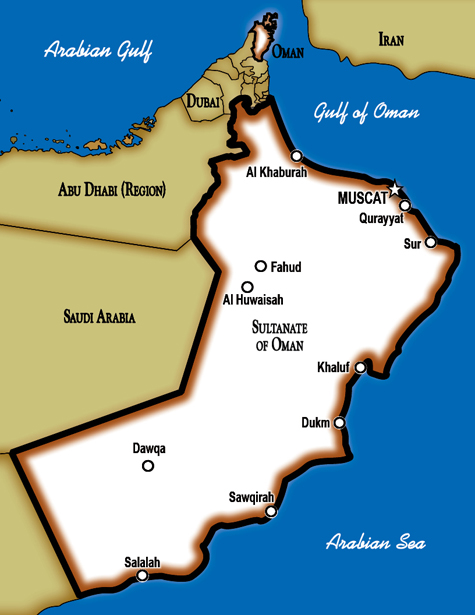
Oman is located on the south-east corner of the Arabian Peninsula. It shares borders with Yemen in the southwest, Saudi Arabia to the west and UAE in the northwest. Oman has over 1,700km of coastline on the Persian Gulf, the Straight of Hormuz, the Gulf of Oman and the Arabian Sea.
It has a varied topography, with fertile coastal plains, mountain ranges and arid deserts.
Oman is a traditional country that was underdeveloped and virtually closed to the outside world until the 1970s. Since then, beginning under the leadership of the late Sultan Qaboos bin Said, the country has progressed significantly through social programs and infrastructure development. The country is safe for travelers, who are welcomed with warmth and pride. Women can travel safely alone but should respect the local culture by dressing modestly.
A land of enormous geographical variety, in just a few days, visitors can experience rugged coast lines, sand dunes, green valleys, misty mountain peaks and pristine, sandy beaches.
Oman is famous for its historic forts. Some of the best examples are located in or near the capital Muscat. Jalali and Mirani forts stand at the entrance to Muscat Bay and date from the early 16th century. Bahla Fort, at the base of the Djebel Akhdar highlands, is a UNESCO World Heritage Site.
Oman's rugged montains offer stunning scenery and opportunities to explore a diverse array of wadis. (Flash flooding can be a serious danger in the wadis, so it’s important to heed posted warnings and to stay out of the wadis if there is any sign of coming rain.)
Desert dunes stretch as far as the eye can see at Wahiba Sands.
Oman's beaches are major breeding locations for various species of sea turtle.
The Dhofar region in the south, with its capital Salalah, is historical as a center of frankincense production and trade. From June-September, monsoon rains and thick fog roll over Dhofar, seasonally transforming the area into a lush tropical paradise, contrasting sharply with the surrounding desert.



 READ MORE ABOUT OMAN